Showing posts with label Tonya Turner Carroll. Show all posts

Monday, November 7, 2016

Art as a Universal Language, Part 7: Why We Should All Be Feminists


Chimamanda Ngozi Adichie, in her "We Should All Be Feminists" TED Talk, asserts that every human being has the responsibility to call him- or herself a feminist.  She points out that when men or women do not embrace feminism, they are literally denying "the belief that men and women should have equal rights and opportunities."

She recounts an instance when she went to a restaurant with a male friend in her home country of Nigeria.  She had to have a man accompanying her in order to enter the restaurant, to guarantee she wasn't a prostitute in search of business.  When she tipped the man who helped them find a parking spot, rather than thanking her, the man thanked her friend.  The man thanked the friend when she paid him because it was inconceivable to 
him that a woman could be successful, educated, possess her own money, or make any independent decisions.  Just as Chimamanda Adichie felt overlooked and discounted, this 
is how many women feel all over the world every day. 

Hillary Clinton campaign poster, by Tony Puryear

November 8, 2016 may be the final day of the 227 year history of exclusively male Presidents of the United States. The population of the United States has been 51% female for a long time.  Likewise, 51% of visual artists today are women, according to the National Museum of Women in the Arts.  In spite of this, the Guerrilla Girls (an art-oriented group of women who fight discrimination), remind us that "Less than 4% of the artists in the Modern Art section of New York's Metropolitan Museum of Art are women, but 76% of the nudes are female."

Is this really who we are--a society that views women so overwhelmingly voyeuristically, but not intellectually or by their level of skill?  Unfortunately, the lack of outcry among women (and men) against remarks by Donald Trump in the 2016 election make it seem so.  

Check out this video about Fierce Women of Art:


In 1971, Linda Nochlin's essay "Why Have There Been No Great Women Artists?" was published.  In it, she writes:  
"Why have there been no great women artists?" The question tolls reproachfully in the background of most discussions of the so-called woman problem. But like so many other so-called questions involved in the feminist "controversy," it falsifies the nature of the issue at the same time that it insidiously supplies its own answer: "There are no great women artists because women are incapable of greatness....The question "Why have there been no great women artists?" is simply the top tenth of an iceberg of misinterpretation and misconception; beneath lies a vast dark bulk of shaky idees recues about the nature of art and its situational concomitants, about the nature of human abilities in general and of human excellence in particular, and the role that the social order plays in all of this."

45 years after Nochlin's essay, in 2016, Artnet News posted the Top 100 Lots by Living Artists: 2011-2016.  This list features the 100 most expensive works of art that sold throughout the world for the highest prices during this most recent five year period.  Not one of the works in those top 100 highest priced acquisitions was by a female artist.

*****

It's certainly time to appreciate the phenomenal women artists in our midst.  They are not only capable of greatness; they've already achieved it ten times over.  It is time to spread knowledge of their works by writing about them, visiting their exhibitions, and collecting their works.  We need to do this not just because they are women, but because they are making incredibly important art that communicates with us through a different lens.

Hung Liu  Duohua:  Falling Flowers  50 x 50" mixed media on panel, 2016

Hung Liu  Dandelion--Cicada  50 x 50" mixed media on panel, 2016

Hung Liu, for instance, is one of the most influential of all women artists painting in the United States today.  Hung labored in the wheat fields of China during Mao's Cultural Revolution; she worked tirelessly for years to get her passport from the Chinese government so she could attend art school in the U.S. She left all she knew behind in China, and came to the U.S. with nothing.  Thanks to her unfaltering work ethic and skill, Hung Liu's paintings are now in virtually every major art museum in the United States.

Chimamanda Ngozi Adichie speaks of being suspected of being a prostitute when she entered any restaurant or hotel alone in Nigeria, but Hung Liu gives the concubines and peasants of China new life in her paintings. She paints the images of these bedraggled women as if they are royalty, surrounding them with fortuitous symbols and gold.  


Hung Liu  Route 66 with Cat  25-1/4 x 31-1/4"  6-plate color lithograph, 2016

Hung Liu  Black Madonna  2-1/4 x 31-1/4" four-color lithograph, 2016

Hung Liu  Route 66  25-1/4 x 31-1/4"  6-plate color lithograph, 2016


Hung Liu turns her attention to themes of American struggle in her latest series of works, inspired by the great American artist Dorothea Lange's Dust Bowl era photographs.  For Hung Liu, "Every day is Thanksgiving, and every day is also Memorial Day."  She memorializes the grit and determination of so many American women with this new body of work.


Hung Liu's artwork is currently the subject of a solo exhibition at American University's Katzen Art Center, coinciding with this momentous election.  This is important because like Hillary Clinton, Hung Liu is a born warrior.  In a true coup for women in contemporary art, the National Portrait Gallery is commissioning Hung Liu to paint great American actress Meryl Streep's portrait.


Another contemporary art icon is Squeak Carnwath.  Carnwath's paintings are in permanent collections in The Metropolitan Museum of Art, Yale University Art Gallery, San Francisco Museum of Modern Art and many more.  

Carnwath is an artist-philosopher whose work opens a portal into our every-day collective consciousness.  Playlists, grocery lists, scam emails, color wheels...all ephemera of our shared human experience.  Carnwath's highly personal symbolism in her art feels like the symbolism we use in our own lives.  She is able to elevate the banal to the beautiful in her paintings.  It would be hard for anyone--male or female--to match the artistic gesture, line quality,  and painterliness in Carnwath's work.
Squeak Carnwath  Trip  70 x 70" oil and alkyd on canvas over panel, 2012

Squeak Carnwath  Short Shuffle  30 x 30" oil and alkyd on canvas over panel, 2014

New Mexico sculptor Karen Yank makes fabulous sculptural public art commissions of monumental scale, in addition to her gallery-scale works.


Karen Yank's Boulder, Colorado Public Art Project, "Current"


There are many more contemporary women artists we need to be celebrating.  Take a moment to look at these amazing artists:

Nina Tichava in her Santa Fe studio


Nina Tichava  Every Other Freckle  40 x 40" painting and collage on panel, 2016

Friday, September 23, 2016

Art as a Universal Language, Part 6: Art as Social Change


by | Sep 23, 2016 | Art as a Universal Language, Blog | 0 comments


Kara Walker‘s “Testimony” reveals the injustice in African American history

Contemporary Syrian war poster portrays the reality of childhood

In previous editions of this blog, I’ve written about the universal symbolic language of art, and visual art as a mode of communication. One of my greatest interests is how art can be used to instigate social change.  In the 1980s, I was awarded the Raoul Wallenberg Scholarship to study the Israeli/Palestinian conflict.  Once I arrived to study at Hebrew University in Jerusalem, I realized I wanted to focus my research on how art can direct attention to major social, political, and environmental urgencies.


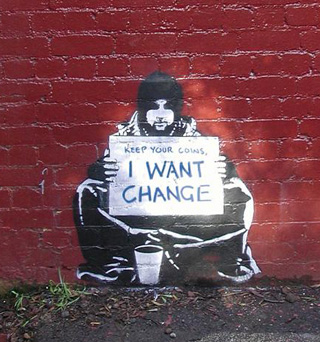
Image by Australian street artist “Meek”, stencil art of his “Begging for Change”

Since the beginning of civilization in Mesopotamia, rulers
used art to depict their elevated status and power. Every
sight-enabled member of the populace understood that the
person depicted largest and closest to the life-giving source 
of the sun, wielded the greatest influence. The social structure
was as simple as powerful=larger; less powerful=smaller.


Victory Stele of Naram Sin, c. 2200 BCE

 
Naram Sin video

When one group overtakes another, it communicates its power
visually, by destroying the most sacred cultural relics of the 
previous culture and supplanting them with visual symbols that
reflect its own ideology. Roman emperors stole Egyptian obelisks
with hieroglyphics boasting of acts of great Egyptian pharaohs.
The Romans erected these obelisks, like cultural hostages, in
front of their own most important structures, to show the 
dominance of Rome over Egypt.  

Likewise, when Christianity replaced pagan spirituality in Rome, 
Christians took this cultural hostage-taking a step further, by 
sticking a cross on top of the obelisk in front of the Roman
Pantheon.  This communicated the ultimate triumph of Christianity, 
over the pagan religions of the past.  This one image of the Pantheon 
below, represents repeated cultural “replacement” from c. 1303, B.C.E., 
to the present day.


Athena, Goddess of Peace and War, intact, in Palmyra 

The same Athena sculpture, after Isis destroyed its head and arms, at end of hall


Destroyed Buddha of Bamiyan, Afghanistan

The Taliban’s destruction of the Buddhas in BamiyanIsis’s 
obliteration of great artifacts in Nimrud–these acts of 
annihilation are acknowledgements of the ability of 
visual images to communicate messages of cultural 
significance to humanity.  Destroying them is like wiping 
out an entire society’s visual language or history.  It is only 
due to their fear of the power of those spiritual images, that 
the Taliban and Isis chose to destroy them.  Perhaps it is the 
power Buddhism gives to the individual for his own self 
guidance, rather than reliance on an external God, that is so  
threatening to their oppressive rule.

What if, instead of destroying works of art because we fear 
their ability to convey important cultural truths, we embrace 
the power of art to help unite turbulent societies? 
In our current environment of incredibly oppressive, 
xenophobic rhetoric, art can--literally--show us a different 
way.  It can present concept and leave the creativity of 
solution to each individual viewer.


Israeli artist Drew Tal grew up in Israel in the 1960s, when the 
country was a mixture of many diverse cultures.  Rather than 
narrowing his perspective due to religious or political differences, 
Tal is fascinated by different customs and beliefs.  He uses his 
photographs to mirror human realities in a neutral manner.  

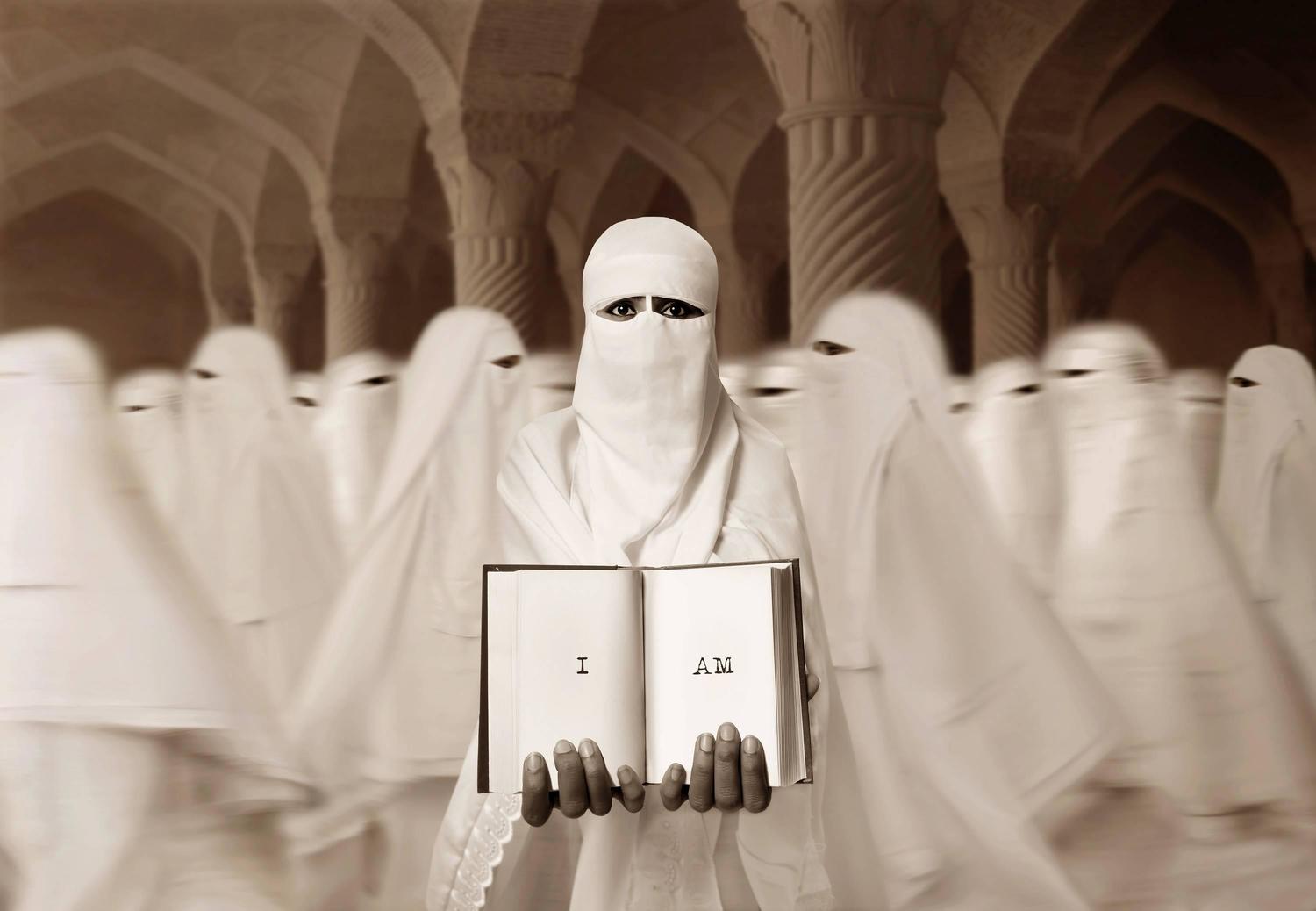
In his “Revelation”, Tal gives the brave words “I Am” to 
Muslim woman who could be considered voiceless.  He allows us 
to perceive her individuality in a sea of imposed homogeneity.  
In presenting this unidentifiable woman to us, Tal reminds us that 
while we are so often inclined to define people by their larger group, 
every single human being is an individual, with the same mother, 
father, sister, brother, relationships we use to define ourselves.

The symbolism in Tal’s “Revelation” is dense.  He “reveals” to 
viewers not only this woman’s individual worth, but he also 
poetically bridges the abyss of misunderstanding between Muslim 
and non-Muslim cultures.  “I Am” is a significant statement, 
appearing in Exodus 3:13–15, when Moses says to God, “If I 
come to the people of Israel and say to them, ‘The God of your 
fathers has sent me to you,’ and they ask me, ‘What is his name?’ 
what shall I say to them?” God said to Moses, “I AM WHO I AM.” 
And he said, “Say this to the people of Israel, ‘I AM has sent me 
to you.’” God

In Tal’s “Revelation”, the “I” singles out an individual from the 
group; the "Am" refers to the universal, shared divinity in every
human being, regardless of political, religious, cultural belief. 
Tal’s art is the kind of imagery that can effect change in the world.

French street artist/photographer, JR, is one of today’s most 
engaging artists, using his art to help people all over the world 
make change.  Rather than just creating images for people to 
ponder, he makes the people themselves into their own art.  
JR takes photographs of people in their communities, or has 
locals photograph themselves, all over the world.  This helps 
people see that they can literally create their own reality, by 
rendering themselves as friend or foe within their respective 
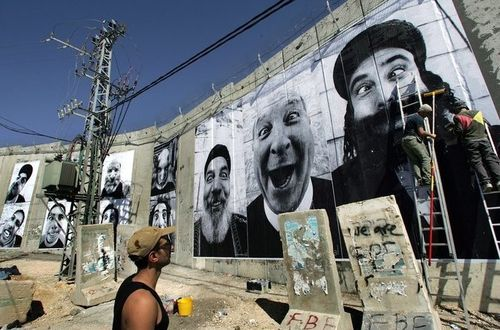
community.   JR won the TED prize.  He asked Israeli and 
Palestinian people to make funny faces, printed monumental 
images of them, and mixed them together on each side of the 
wall separating the two areas.  He uses his art to magnify our 
similarities, rather than our differences.  His art opens our 
eyes to the idea that we can share humor, rather than 
animosity, even in the face of major differences.


JR’s Inside Out project in Israel


Visual images transcend barriers of specific spoken and 
written language.  Visual language is universal, touching 
each human being on a shared somatic level.  Therefore, 
artists have a unique responsibility to reveal issues we need 
to confront as a global human family. By changing the context 
of these images, visual artists can allow us to “see” a different 
way forward. Art can, in fact, change the world in a positive 
way, if we are open to its messages.

End of Part 6

Tonya Turner Carroll
Turner Carroll Gallery and Art Advisors
Santa Fe, New Mexico, USA
turnercarroll.com

Sunday, December 20, 2015

Art as a Universal Language, Part 3: How Art Unites World Religions


In Art as a Universal Language, Parts 1 and 2, I address some of the universal visual symbolism artists have used since the beginning of human civilization.  Certain symbols have become "visual code," allowing people from vastly different cultures and generations, to comprehend each others' values and challenges.  In this, Part 3, of Art as a Universal Language, I explore how art evinces the universal similarities of our deepest human spiritual beliefs, and how important it is to use this shared symbolism to unite us, rather than as a weapon to divide us.

•••

"If the doors of perception were cleansed every thing would appear to man as it is, Infinite.  For man has closed himself up, till he sees all things thro' narrow chinks of his cavern."

William Blake, from Marriage of Heaven and Hell
•••


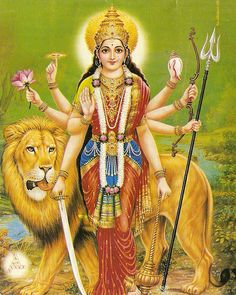
top left: painting of Seraphim, from Judaeo-Christian religious art; Hindu goddess Durga; left: The Resurrection of Christ, from the Right Wing of the Isenheim Altarpiece, circa 1512-16, Matthias Grünewald
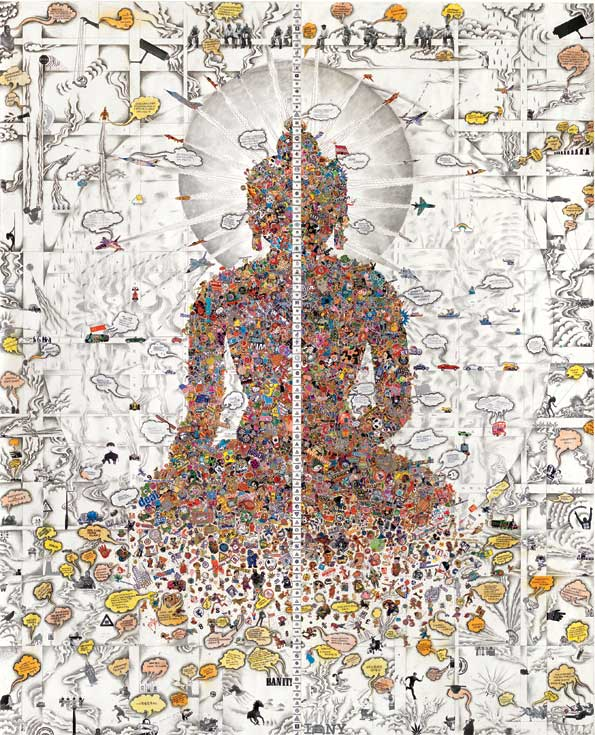
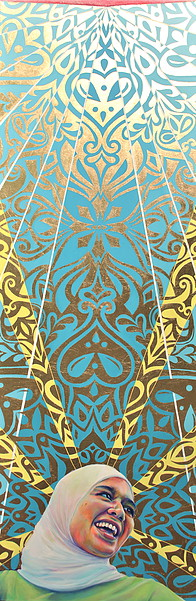
bottom left: Dissected Buddha, Gonkar Gyatso (born Lhasa 1961), 2011; Inner Sun, Saba Barnard, 2015; right: Native American drawing of ceremonial costume


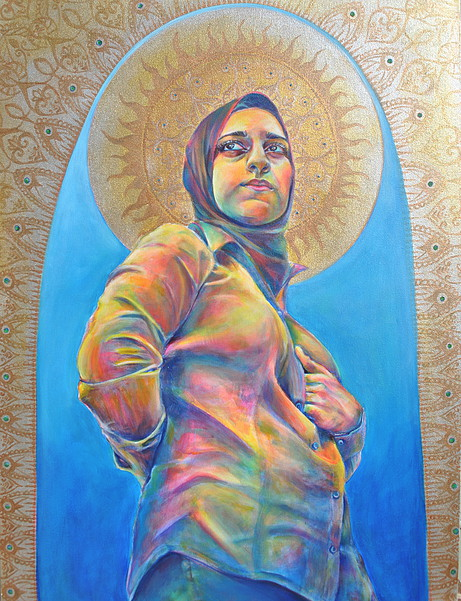
It’s obvious from the Judaic, Hindu, Christian, Muslim, Native American, and Buddhist images above, that most of the world’s great spiritual philosophies share the use of the sun symbol, or halo, to depict the sanctity of their subject.  In the first image, the Serafim (“burning ones”) heads are surrounded by golden halos that glow like the sun.  The Serafim represent the Judaeo-Christian religion.  The Hindu artist who created the next image of Hindu goddess Durga has glorified her with a glowing halo, as well as a gesture of blessing. The risen Christ is surrounded by a halo so large and brilliant that the artist’s passionate message is clear--he declares that Jesus has risen to save the world.  Equally joyous, is the image by contemporary Muslim feminist artist, Saba Barnard.  In her “Inner Sun,” a halo radiates outward from the artist’s ecstatic smile, embellished with the glorious gold leaf and calligraphy that adorn the finest works of Islamic art.  The seated Buddha, again shows the halo of enlightenment, surrounding the head of the Buddha.  True to the nature of Buddhist philosophy, the image of the Buddha is “dissected”--a potent reminder of the importance not to hold on too tightly to the objects or dogma of this material world.  On the right, the Native American drawing shows a ceremonial costume of a dancer wearing an elaborate headdress.  The headdress looks remarkably like a halo, and we know that Native American religions profoundly honor the sun.
This universal visual language of the halo or sun communicates our global similarity on a deep human level.  Though our spiritual philosophies have grown to differ, they originate from the same impulse--to honor that which we hold most sacred, and often the spiritual leaders we regard as most enlightened.


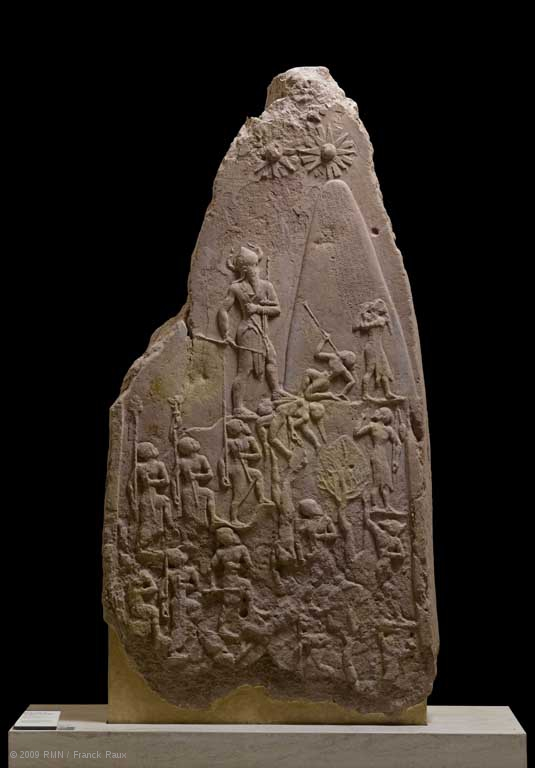
The Victory stele of Naram-Sin  (c. 2250 BCE), Collection of the Louvre, Paris


Artists from all over the world have harnessed the power of the solar disc/halo symbol since the beginning of global recorded visual history. Some of the most important ancient images we can see feature the sun symbol. The sun is the life force of the plant and animal world, thus one of the most powerful determinants in ancient civilization.  Man had to learn to work with the sun to grow food, and had to shelter from its heat. When the sun shone benevolently down on man, the populace regarded this as a blessing.  Thus, when particular leaders in political or spiritual life were victorious in battle or agriculture, they were often memorialized in artworks rendering them in special relationship with the sun. In this Mesopotamian Victory Stele of Naram-Sin, Naram-Sin is positioned closest to the divine solar disc, illustrating his earthly divinity.  To further assert this point, he wears a horned helmet--a typical attribute of a Mesopotamian god.  


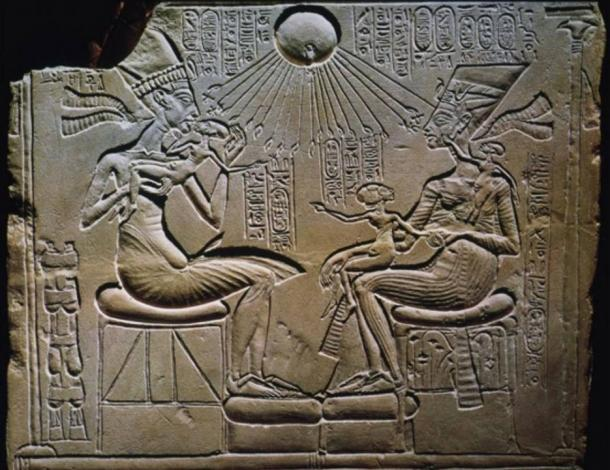
Akhenaten, Nefertiti, and their children blessed by the Aten (Solar Disc)


In the image above, you can see how the sun (the solar disc) radiates warmth, happiness, and prosperity upon Egyptian rulers Akhenaten and Nefertiti and their children.


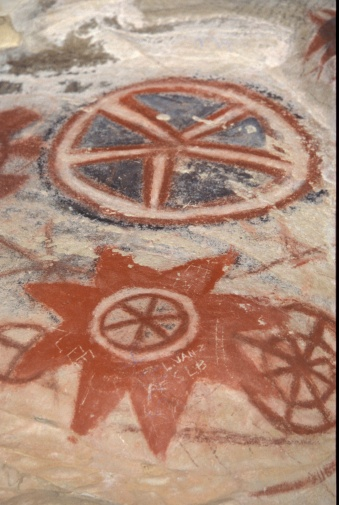
left: Chumash Indian Cave Painting, c. 1000, Santa Barbara, California, image courtesy Getty Images, Marilyn Angel Wynn; right: Phaistos Disk, c. 1700 BCE, Crete

The solar disc became so strongly associated with wisdom and protection, that it was adopted by religious and political leaders throughout history.This Minoan disc (left), only partially deciphered, speaks of “shining mother”,  according to Gareth Owens (Technological Educational Institute of Crete), in collaboration with John Coleman, professor of phonetics at Oxford.  Approximately three thousand  years later, in what is now the United States, sun images were being featured in Native American cave paintings.  In India, the festival of Ratha Saptami celebrates the transition from winter to spring.  It is dedicated to the Hindu Sun God named ‘Surya’, which means "sun".


Mosaic from the House of Amphitrite, Bulla Regia, Tunisia, image courtesy Euratlas.com, c.138-193 A.D.


l


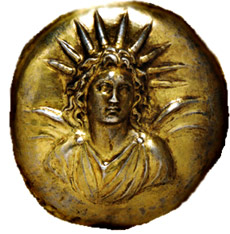
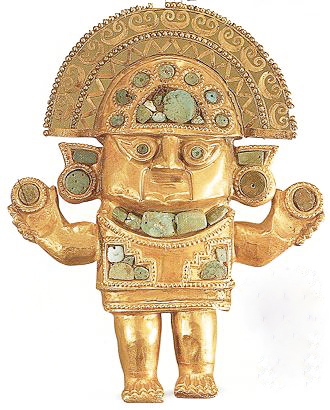
left:  Greek deity image; center: ''Jahangir Preferring a Sufi sheikh to Kings'', miniature painting by Mughal artist Bichitr, c. 1620 watercolour and gold on paper; right:  Incan deity image, Peru


Greek, Roman, Islamic, and Incan spirituality all used the solar disc/halo to depict a person’s enlightenment.  It’s significant to note the widespread use of gold, by societies as far apart as Peru, Greece, and Iran, to depict these revered, haloed individuals.  Gold has obvious association with the sun, due to the fact that it is the closest hue to the celestial, glowing, source of light, warmth, and life.


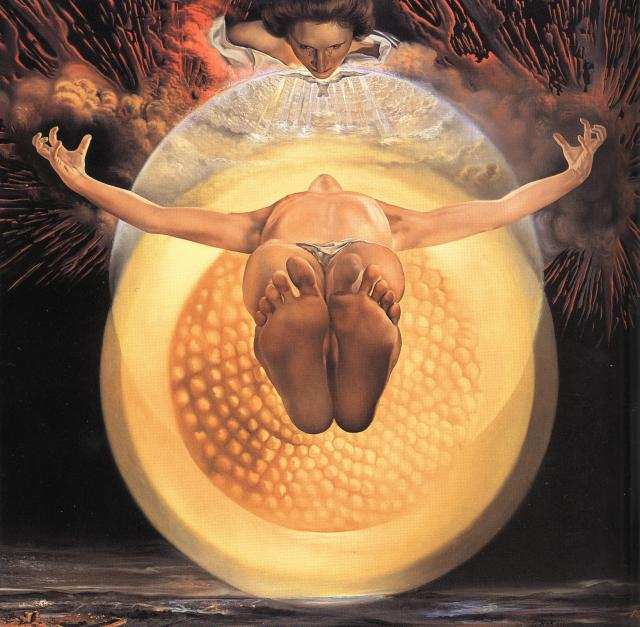
top: Illuminated manuscript featuring Jesus as sun; center:  Golden mosaic of Jesus with halo from Ravenna, Italy; bottom: Ascension of Christ, Salvador Dali, 1958


Christianity also adopted the sun symbol of the halo, to depict the enlightenment of Jesus. Many of the Europe’s greatest works of art, such as the "Ascension of Christ" by Salvador Dali, above, are those which utilize the solar disc/halo to show the immanent light of Christian spirituality.


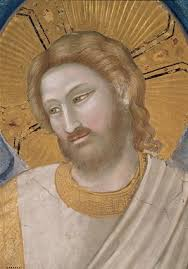
Ieft: Hope, 2015 painting by Muslim female artist, Saba Barnard; right:  Stories of the Passion of Christ of The Resurrection, by Giotto, 1304

It’s obvious from these works of Islamic and Christian art, that both religions utilize the sun-golden halo to symbolize the sacred grace of the enlightened human being.  To place the halo around the figure of Jesus, as in Giotto’s painting on the right, is something we are used to.  But when a contemporary artist combines the halo with a female lay image, exquisite calligraphy and other devices of Islamic art, we are forced to consider our own acceptance of the sanctity of every human life.  The combination of these two images shows us that we can use visual language to understand our similar values, even when the division between our ideologies seems too vast.


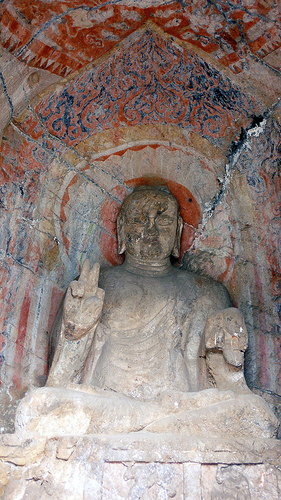
left:  Gold and stone tile mosaic of bearded Jesus, Basilica of Sant’Apollinare Nuovo, Ravenna, Italy; right: Photo by Xuan Che, Amitabha (buddha of love and compassion) with halo, c.500 AD. The Longmen Grottoes, Henan, China; below: image of Indian god Vishnu


The images above feature artworks from Christian, Buddhist, and Hindu spiritual philosophy. The images include not only the solar disc/halo of enlightenment.  They include another important element of visual symbolism--the gesture with the right hand.  This hand blessing is universal visual code for blessing and protection.  Since Mesopotamian times, the hand has been used in visual renderings to signify protection.  


Below, you’ll see the Hamesh hand (Judism), or the Hand of Fatima (Islam), which has been used since ancient times to signify protection in Jewish and Islamic spiritual cultures.


Hamesh Hand, image by David Yohanan

It is my sincere hope that this exploration of universally shared visual symbols for our spirituality will help us appreciate each other as human beings. Regardless of what spiritual philosophy we may practice as individuals, the images I've included in this post remind us that humanity has always valued the predictability of the life-giving force, enlightened thought, and protection, above all else. This is what we seek through our spiritual practices. May we use these spiritual practices to better appreciate and understand our fellow (and equal) global citizens, rather to condemn them for their differences from ourselves.

Tonya Turner Carroll

Turner Carroll Gallery and Art Advisors
725 Canyon Road, Santa Fe, NM 87501
USA
TurnerCarroll.com